This blog documents how the idea for a timber harvest at Lennox Model Forest came to be and how forest measurements informed which trees would be marked for harvesting.
Much of the tree marking for a timber sale at Lennox Model Forest has been completed. I thought it could be helpful and interesting to document the planning we have done to get to this point. Over the next series of blogs, I’ll cover the rationale for a timber harvest at this time and the field data collection we completed to decide which trees to harvest. I’ll show you what timber cruising (forest inventory work) and tree marking looks like. Eventually, I hope to write a blog that documents the harvest. Why? Because many family forest landowners will, over the course of their land tenure, need to make decisions about harvesting timber on their land. This blog can serve as a resource for forestry terminology, which is helpful for conversing with peers and professionals, and generally what goes on when planning out a harvest.
The initial push for a timber harvest at Lennox came from their consulting forester Rod Jones, who observed signs of the emerald ash borer near the entrance to the model forest. You can learn more about EAB by reading this blog.
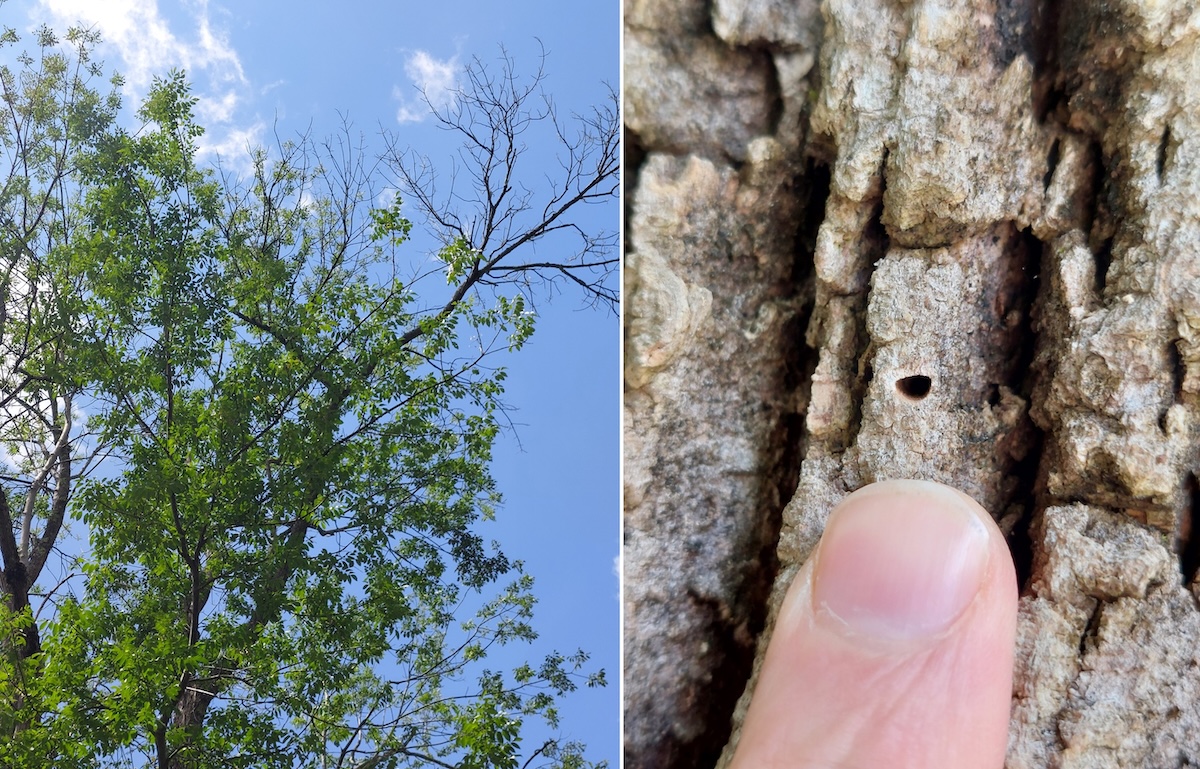
(Left): Canopy die-back on an ash tree. (Right): D-shaped exit hole on an ash tree’s bark.
Rod wanted to liquidate the ash before the trees died and lost their economic value. We agreed with Rod about salvaging the ash. We also saw a timber harvest as an opportunity to re-inventory the trees in their various compartments to inform a larger harvest that showcased multiple silvicultural treatments. Think of compartments as designated areas that represent different ways of managing a woods. Silviculture is defined as the art and science of influencing the growth, composition, health, and quality of forests and woodlands to meet the needs of the landowner and society.
One harvest objective was to increase forest habitat diversity for songbirds. Audubon New York Forester Claire Mann coordinated bird point counts in 5 Lennox Model Forest compartments on June 20, 2024. Bird point counts took place between roughly 7:15 AM and 8:30 AM. A technician listened for and made observations of birds for a 10-minute sampling period in each of the 5 compartments. The goal was to detect as many bird species as possible to give us an idea about bird species diversity.
23 bird species were detected in the 2024 session, including 3 New York State species of greatest conservation need: black-throated blue warbler, scarlet tanager, and wood thrush. Audubon NY did another bird point count at Lennox in June 2025.
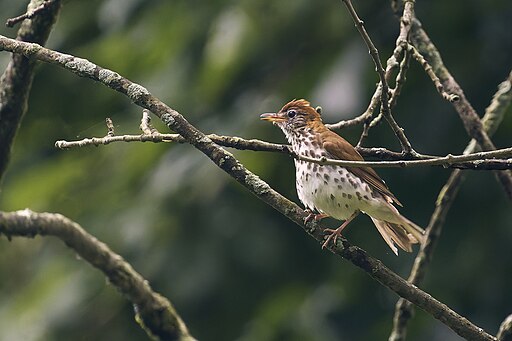
Wood thrush.
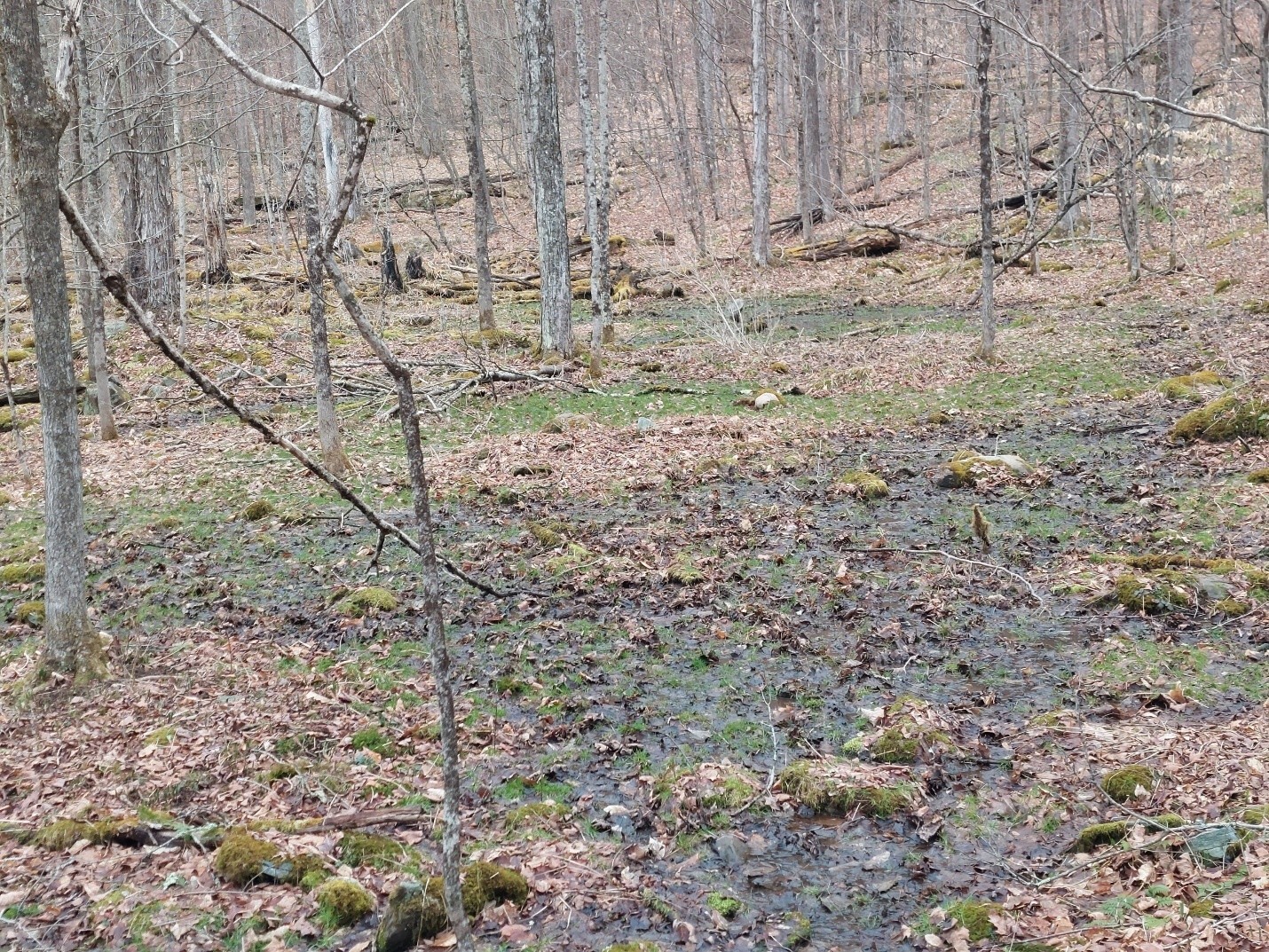
Lennox forest habitat is mature. It lacks young forest. There isn’t much understory or mid-story vegetation.
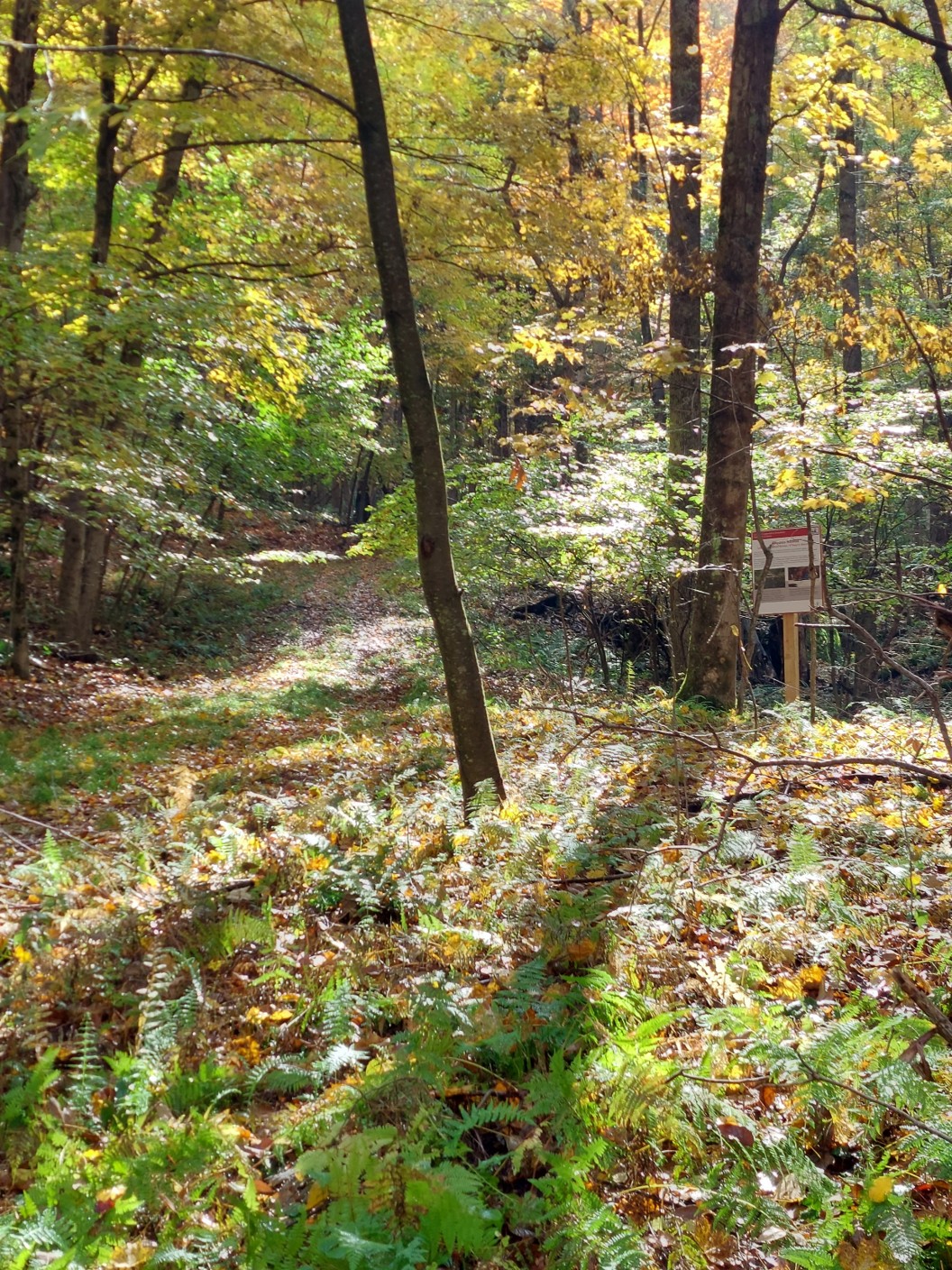
Mature, Northern Hardwoods forest at Lennox.
Young forest provides habitat for nesting birds and post-fledging birds seeking cover and forage. Vertical structural diversity (understory and mid-story layers) does this too.
Check out this dense vegetation coming back after a clearcut.
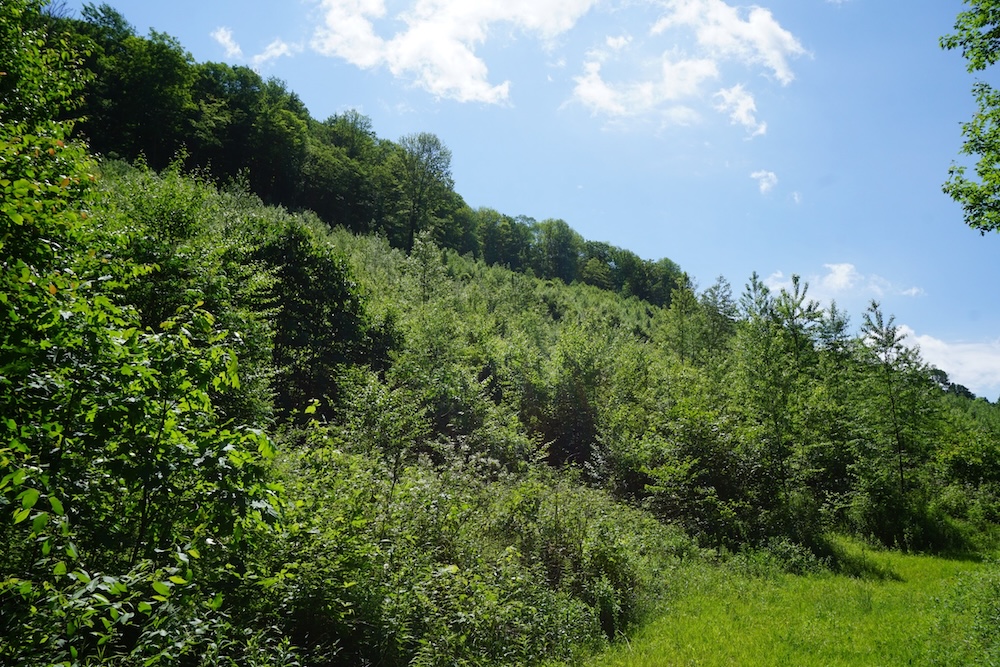
We can create young forest habitat with small patch clearcuts and heavy thinning around crop trees. This type of cut is known as an irregular shelterwood harvest. Deer will want to eat young seedlings trying to grow up after the cut, but we can hunt them to reduce their numbers and we can exclude them with fences or slash walls (deer exclosures).
To provide this much needed habitat type, and to serve as a clear example of forest management for bird habitat, Claire prescribed an irregular shelterwood harvest for Compartment G to attract the cerulean warbler, which is an Audubon priority species and New York State species of greatest conservation need. An irregular shelterwood involves cutting trees such that the remaining forest has a post-harvest basal area of 40-60 square feet per acre. Small patch clearings, one quarter to 2 acres in size, are interspersed randomly throughout the harvest area as well. The aim is to retain large diameter trees (> 16 inches in diameter) with a focus on keeping sugar maple (preferred by cerulean warblers) and removing red maple and red oak.
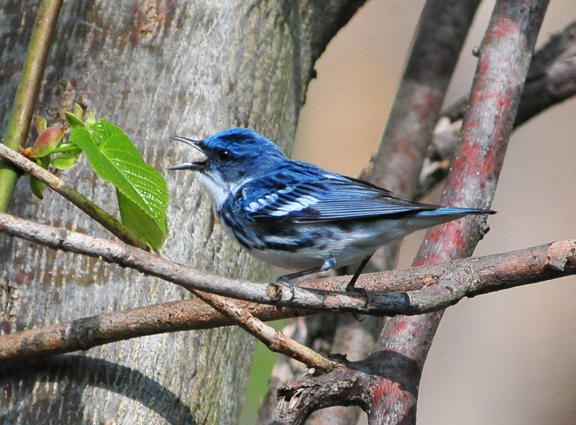
Cerulean warbler
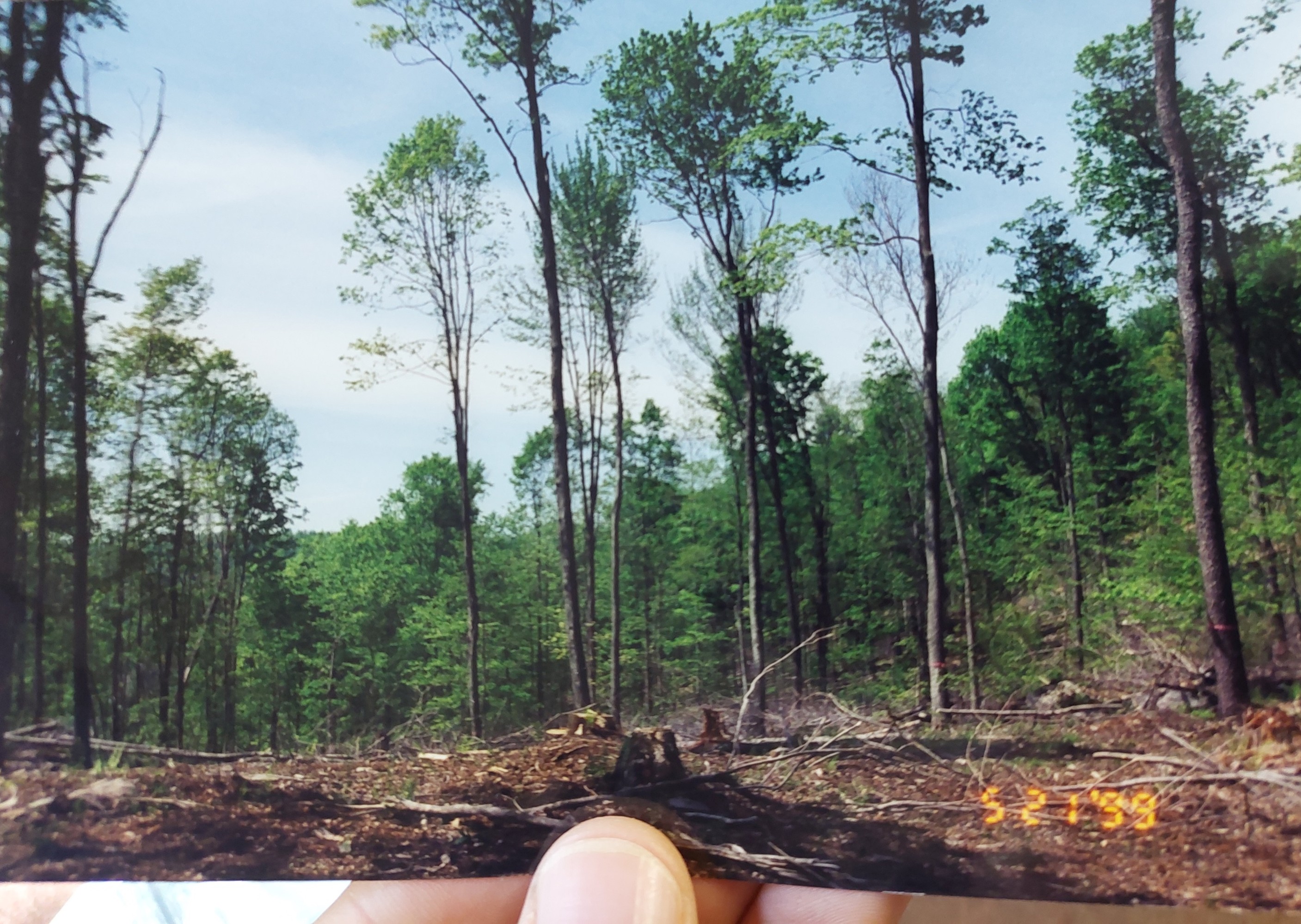
What does a shelterwood harvest look like? The photo below is a shelterwood cut from the 1999 Lennox harvest. Notice the trees left behind. This time around, we will look to retain larger sugar maple trees.
In addition to the forest bird data, we also measured the amount and quality of trees throughout the model forest from July 2024 to March 2025. 12 compartments were measured in total.
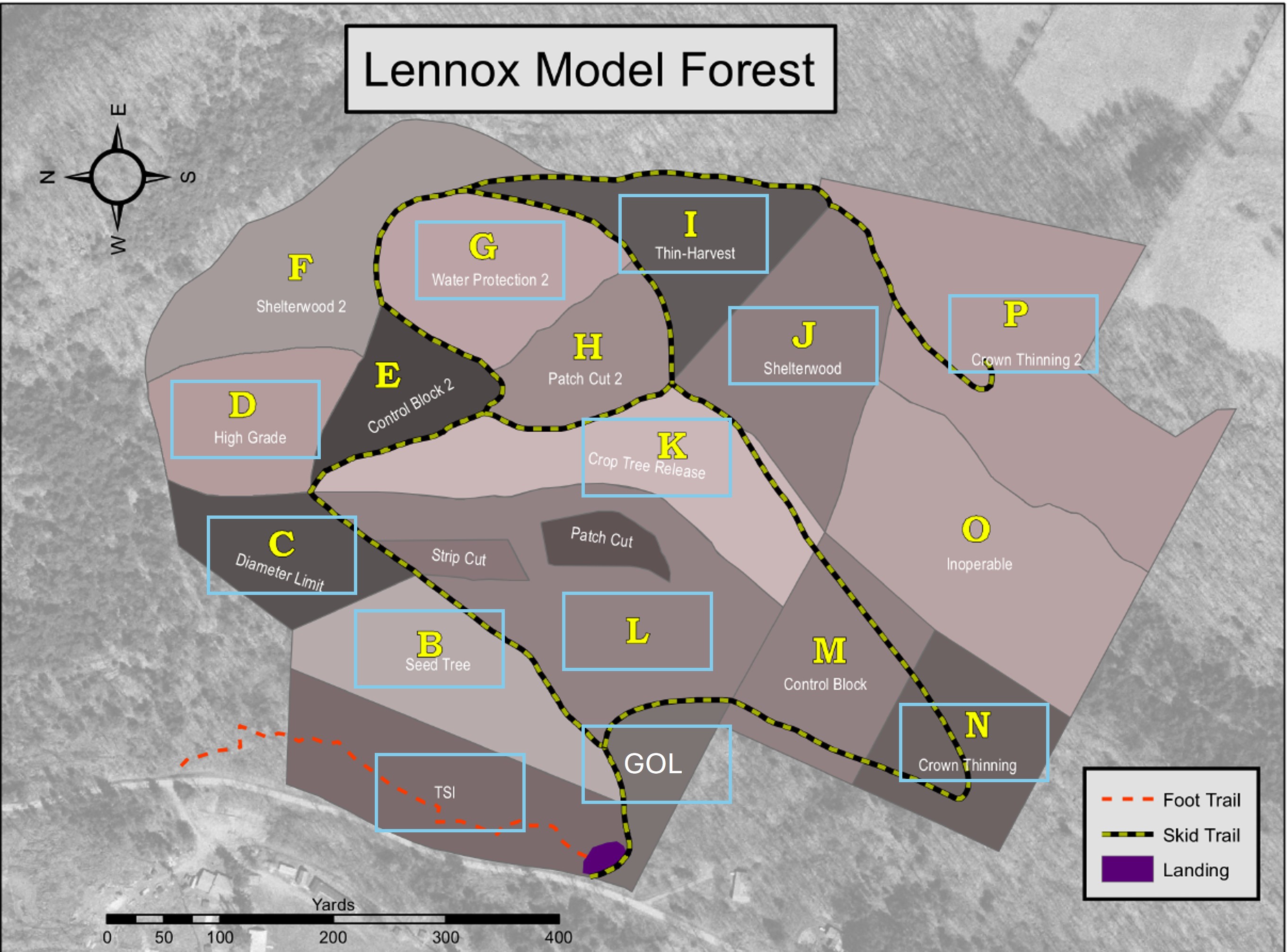
Map of Lennox Model Forest in Delhi, NY showing the different forest compartments. Blue boxes indicate compartments where forest inventory was completed in 2024-25.
We measured 7 to 8 plots per compartment using a 10-factor prism. The person using the prism decides which trees are “in” the plot and for each tree, we identified tree species, we measured tree diameter at breast height (DBH), and we estimated the number of 16-foot sawtimber logs and 8-foot firewood bolts. Note that tree DBH is measured 4.5 feet off the ground. These measurements gave us information about tree species diversity, stocking density, and commercial volume in the plots we measured.
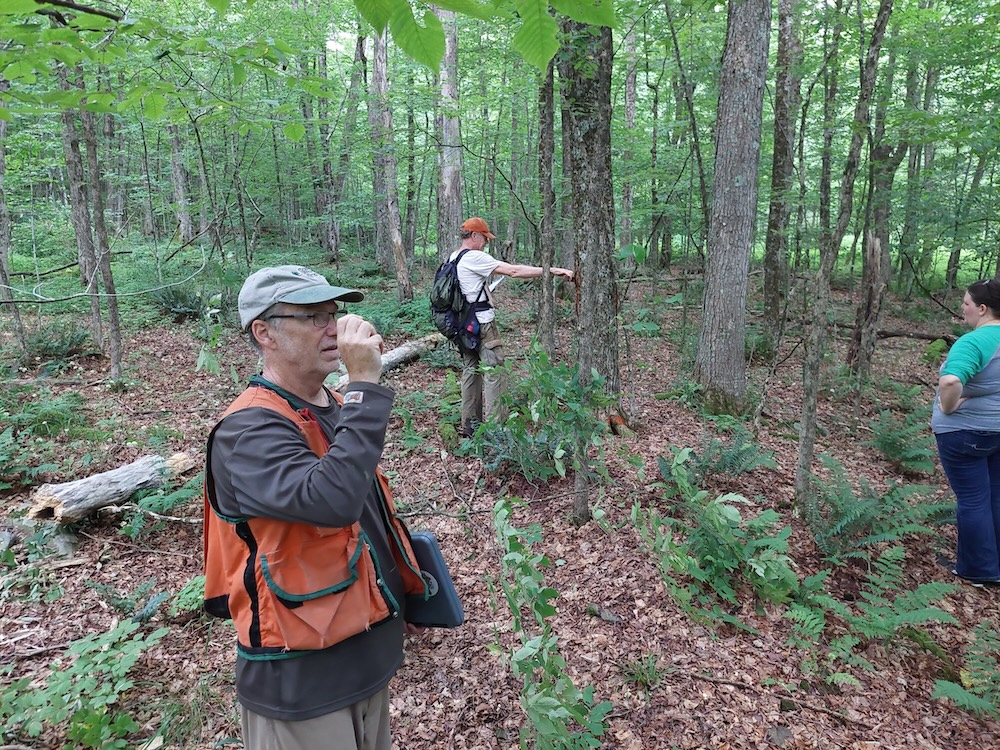
René Germain using a 10-factor prism to measure basal area.
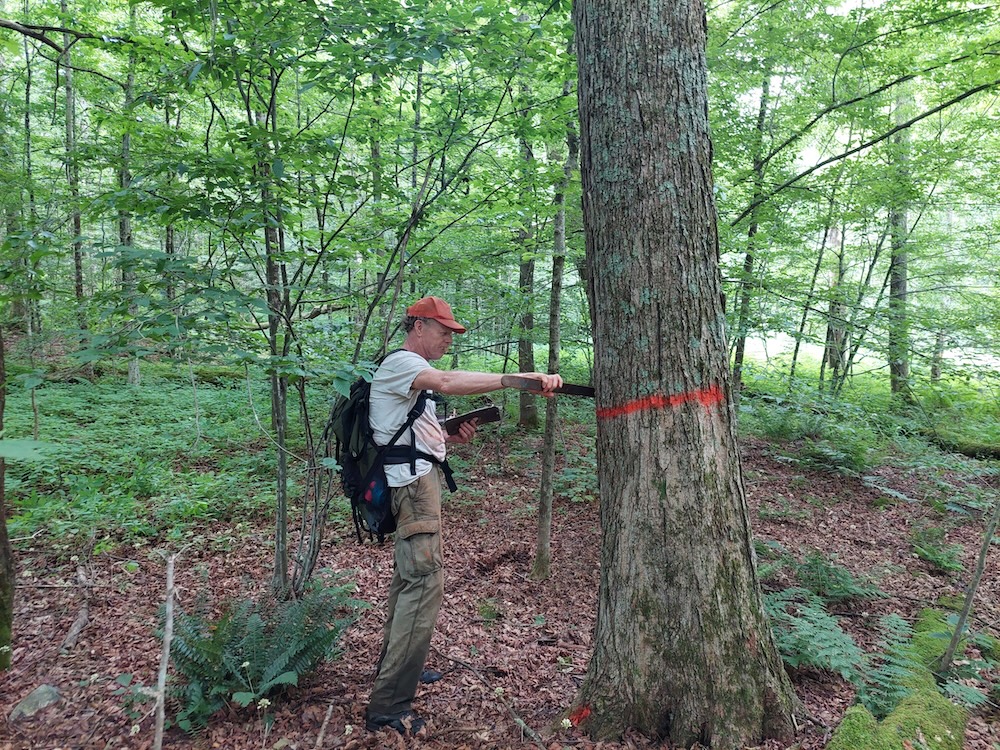
Rod Jones using his stick to estimate tree diameter at breast height (DBH).
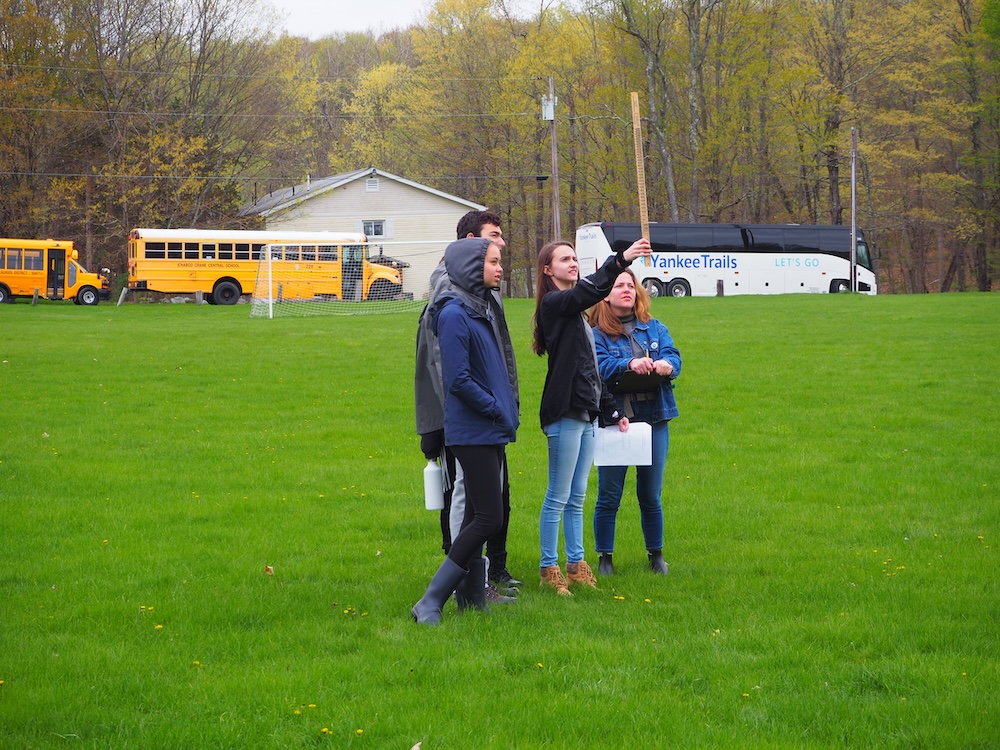
Envirothon participants using a Biltmore stick to estimate tree height. You can also use this tool to estimate the number of merchantable logs in a tree.
The forest inventory comprised 77 prism plots across 64 acres. The average basal area was 94 square feet per acre. The top 5 species in terms of board-foot volume (International Rule) were as follows: 1) Sugar maple (142,285 board feet), 2) Red maple (62,333 board feet), 3) White ash (23,365 board feet), 4. Black cherry (14,332 board feet), and 5. Northern red oak (7,216 board feet). For reference, 1 tri-axle log truck can carry 3,500 to 4,000 board feet of wood. A board foot is a unit of volume for lumber, representing a piece of wood that is 1 foot long, 1 foot wide, and 1 inch thick, or equivalent volume.
Taking the forest and bird data into account, SUNY-ESF Professor and Model Forest Chair René Germain prescribed the following silvicultural treatments:
- B: Finish the seed tree harvest on the southern half
- C: No Treatment, stocking too low
- D: No Treatment, stocking too low
- F: Remove overstory seed trees from 1998 shelterwood (it’s time) – acceptable regeneration
- G: Irregular shelterwood (per Claire)
- H: Three quarter-acre patch cuts (working off of 1998 patch cuts)
- I: No Treatment, stocking too low
- J: No Treatment, poor regeneration, consider under-planting demonstration
- K: Light crown thinning with focus on bigger red maple and white ash
- L: 2-acre clearcut (for early succession bird habitat) – demonstrate slash wall (as per Peter Smallidge)
- N: No Treatment, stocking too low
- P: Timber stand improvement – leave sugar maple crop trees – remove beech, red maple, white ash – target a residual basal area of 90 square feet
- No harvesting in Control blocks
- TSI block: Judicious salvage of white ash sawtimber
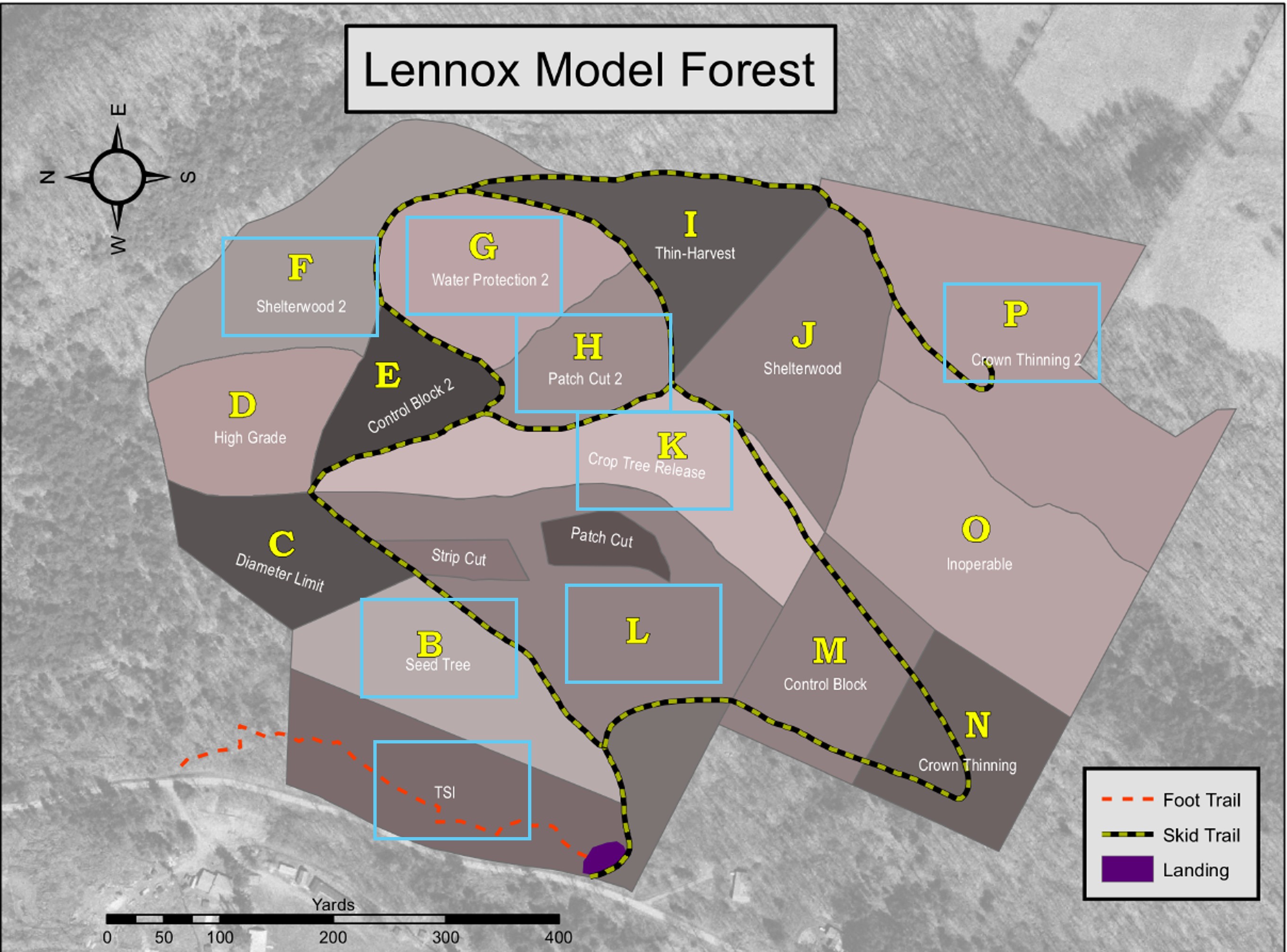
Blue boxes highlight compartments where harvesting is being planned.
On the next blog, I’ll document areas that we want to protect during the harvest.