In this blog, I share what I learned about tree marking for a timber harvest on Lennox Model Forest.
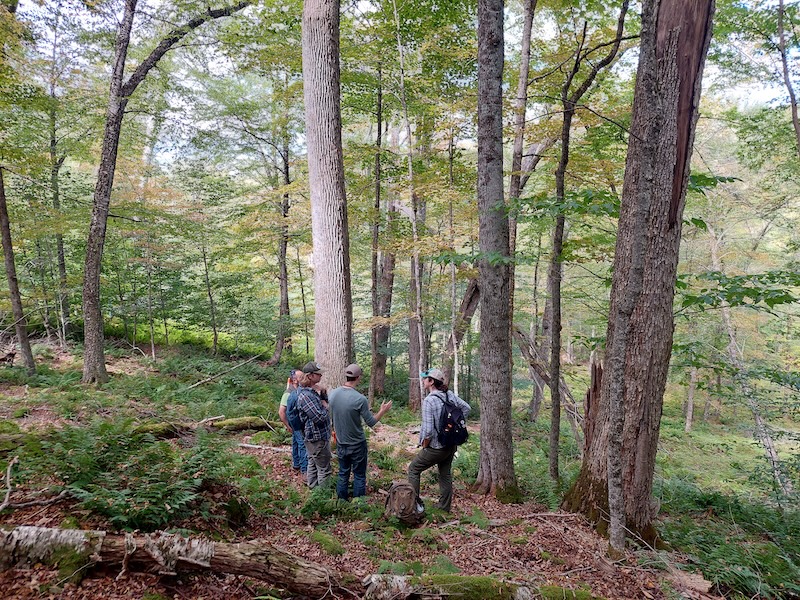
On July 8, 2025, we marked trees to be harvested for the irregular shelterwood, a 1.6-acre clearcut, and three quarter-acre patch cuts. We started with the irregular shelterwood in Compartment G. Minding the wetland boundary, René Germain used a 10-factor prism to estimate basal area of multiple plots. The goal was to bring the basal area down from roughly 90 square feet per acre to about 50. René selected about 4 or so trees per plot to be harvested. Usually, 3 of them were firewood trees and 1 was a sawtimber tree (used for lumber).
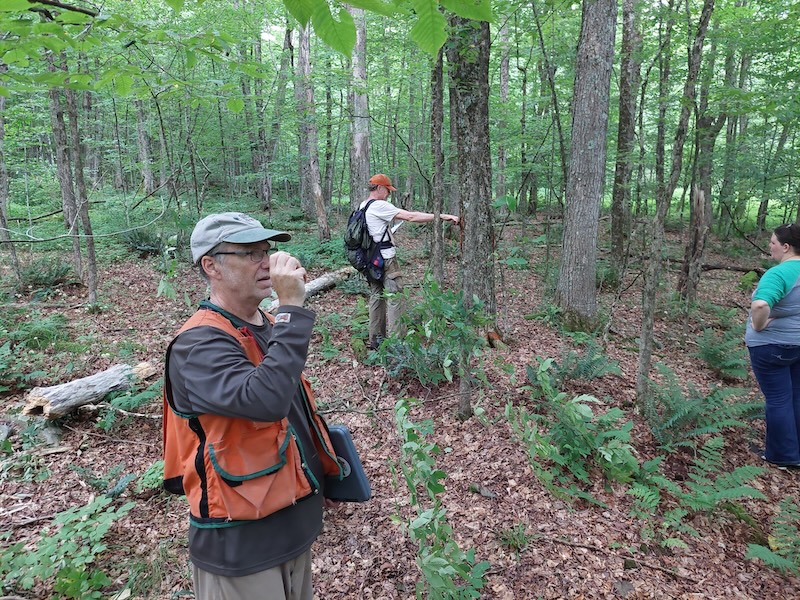
René estimates basal area with a 10-factor prism while Rod estimates wood volume. Corinne Tompkins looks on.
Rod marked the trees to be harvested with red paint. He used vertical stripes for firewood trees and horizontal stripes for sawtimber trees.
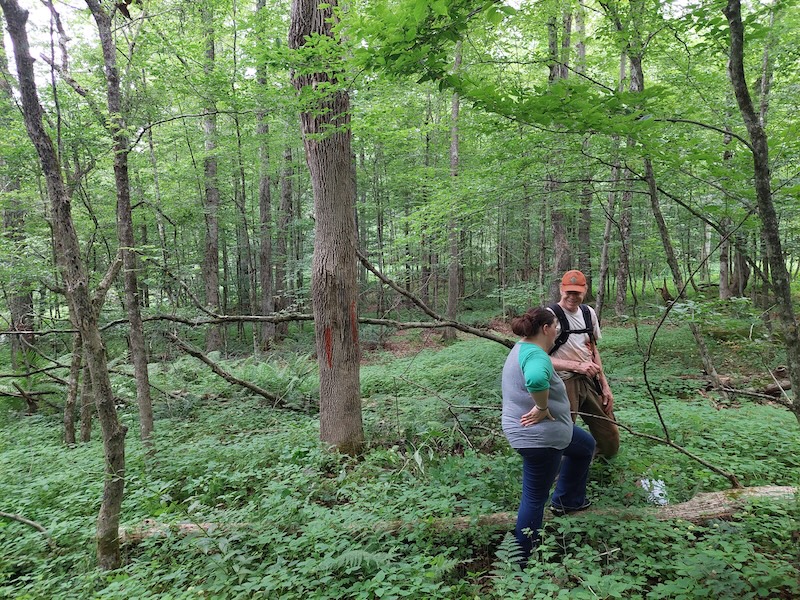
An ash firewood tree marked with vertical stripes.
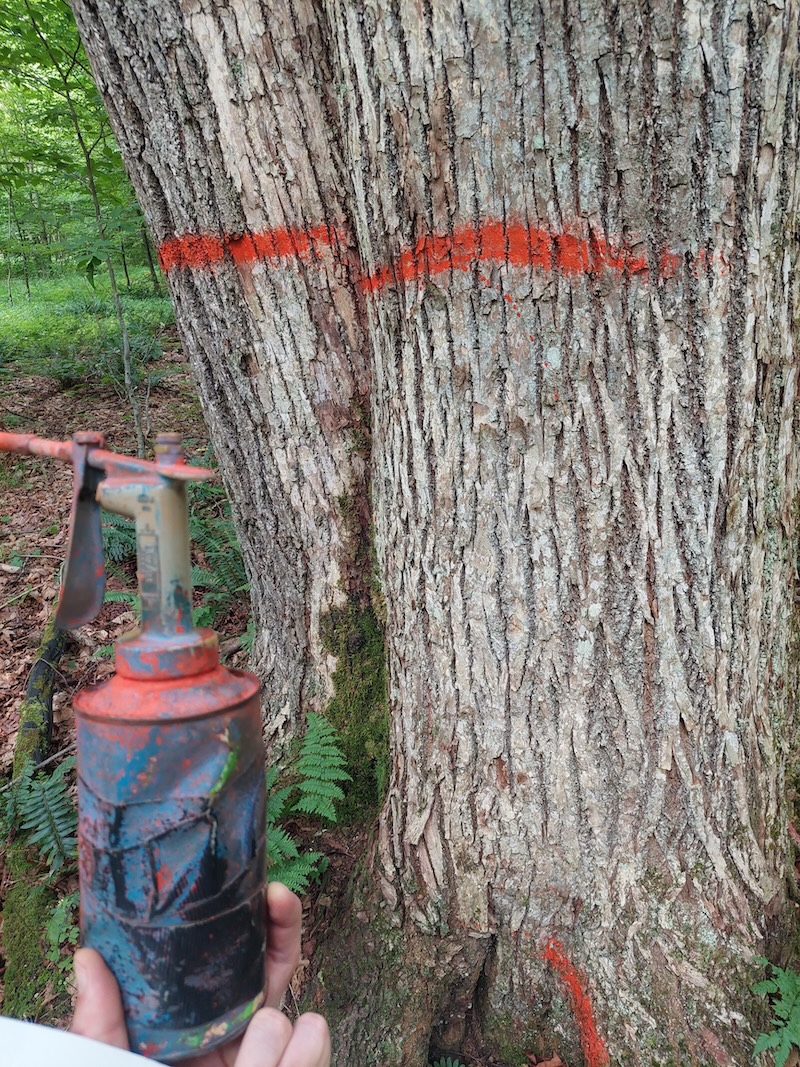
Horizontal stripes on this group of basswoods denotes that they are sawtimber trees. The red stripe at the base of the tree will show that this was a marked tree after the tree has been cut. I had to include Rod’s famous paint gun in the photo.
Rod used a Biltmore stick to estimate tree diameter at breast height (DBH, measured 4.5 feet off the ground) and the number of sawlogs in each sawtimber tree using half-log increments. 1 log = 16 feet. Knowing tree diameter and the number of sawlogs in a tree, Rod used an index to estimate the log volume in board-feet. For example, the Biltmore stick in my office shows that a 16-inch diameter tree with 1 sixteen-foot sawlog is equivalent to 106 board feet (using the International quarter-inch rule FC-78). Assuming a tri-axle truckload of 4,000 board feet, it would take about 38 such logs to make a load.
Sometimes Rod would write a number on the sawtimber trees. I can’t remember whether this was the board-footage or the dollar value of the standing tree. I believe it was the former.
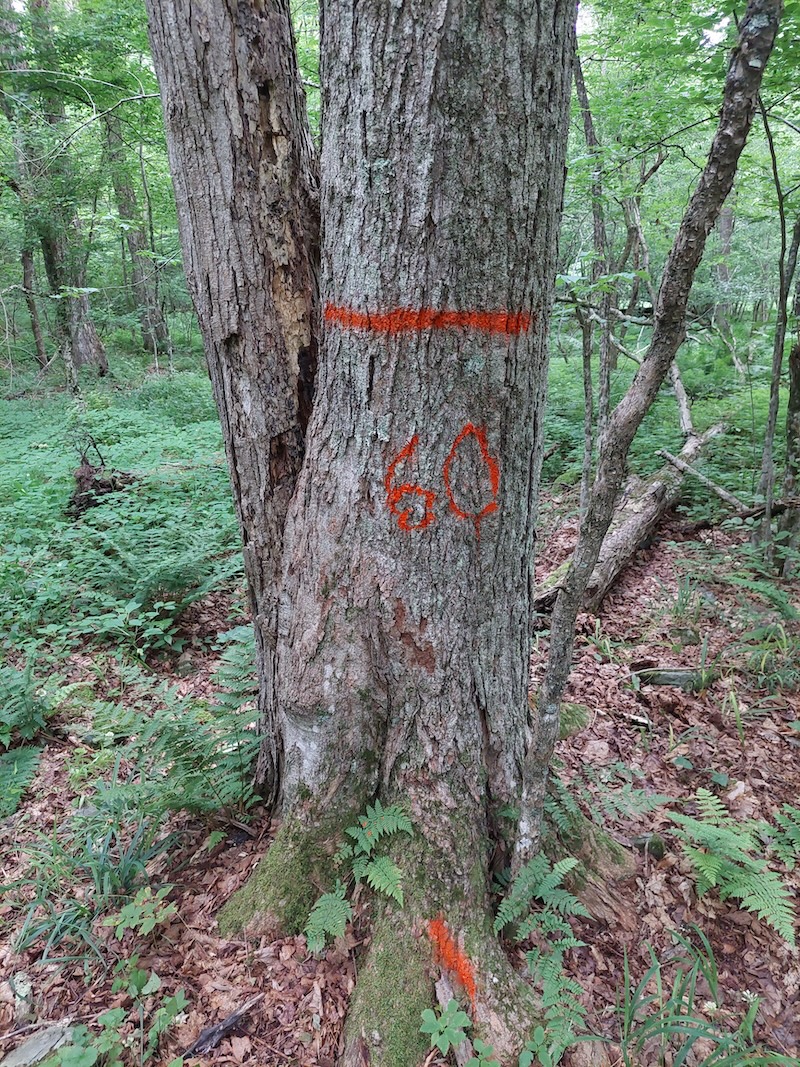
Sugar maple sawtimber tree with what I believe is the board-footage value of the sawlog.
For firewood trees, Rod used estimates of tree diameter and the number of 8-foot bolts in the tree to estimate firewood volume in cords. A bolt is an 8-foot log with a minimum diameter of 5 inches. A standard cord is the equivalent of a stack of wood that’s 8 feet long, 4 feet high and 4 feet wide (128 cubic feet). A cord’s wood content (excluding bark and air space between stacked pieces) varies from about 65 to 95 cubic feet depending on the piece’s diameter, roughness and crookedness (University of Minnesota Extension article, Sampling and Measuring Timber).
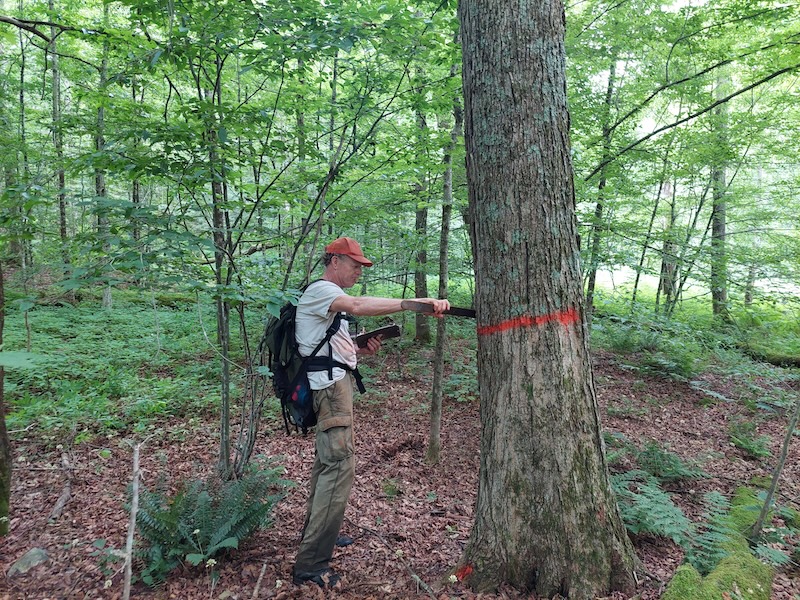
Rod uses his Biltmore stick to measure the DBH of a nice sugar maple sawtimber tree.
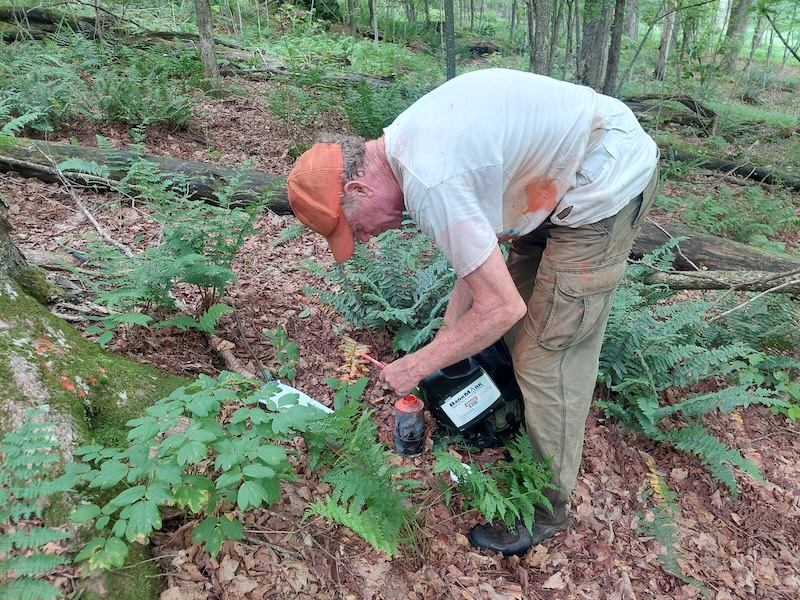
Rod refills his paint gun.
With this being a model forest harvest for research, demonstration, and education, we attempted to incorporate the Department of Environmental Conservation’s harvest retention practices with an eye towards wildlife habitat. Practices include snags (dead trees) and cavity trees (live or dead), each at rate of four trees per acre.
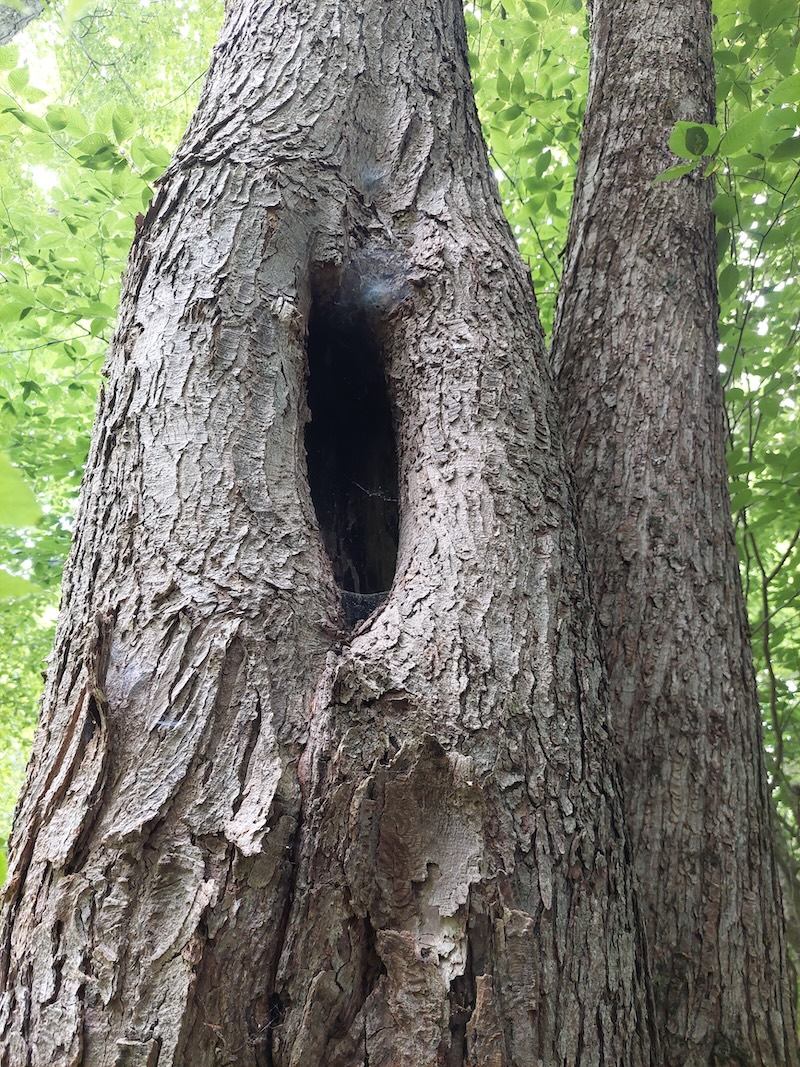
A living cavity tree. A red maple.
Other considerations include leaving coarse and fine woody debris on the forest floor. The coarse woody debris standard being 3 logs per acre that are > than ten inches in diameter at the small end and at least sixteen feet in length. The fine woody material retention practice means retaining 20% of material ≤ six inches in diameter. The latter should be no problem to achieve with a tree-length operation, where felled trees are topped and limbed in the woods before the stems are extracted to the landing.
We finished the day by marking 3 quarter-acre patch cuts and a 1.6-acre clearcut in Compartments H and L, respectively. Inside these areas, all trees will be cut. Rod marked the merchantable trees.
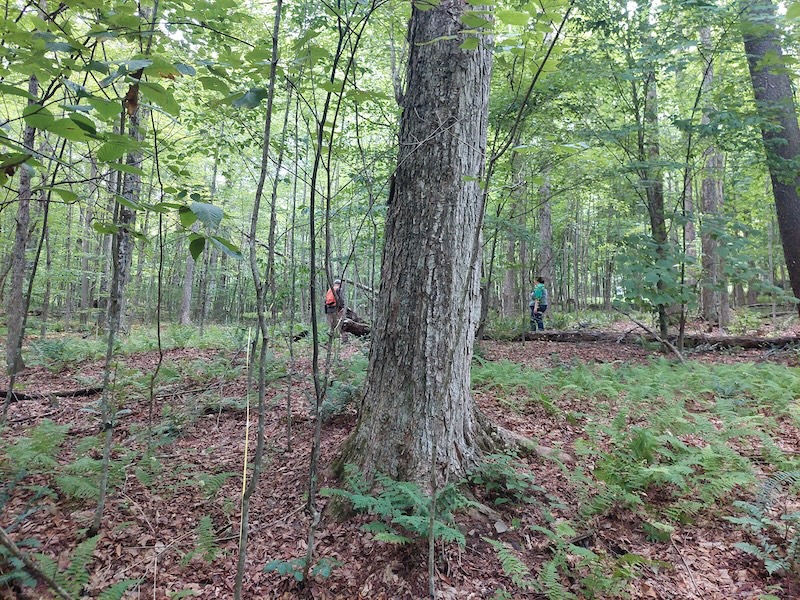
René and Corinne mark the boundary of a quarter-acre patch cut. The big sugar maple and black cherry are IN the patch.
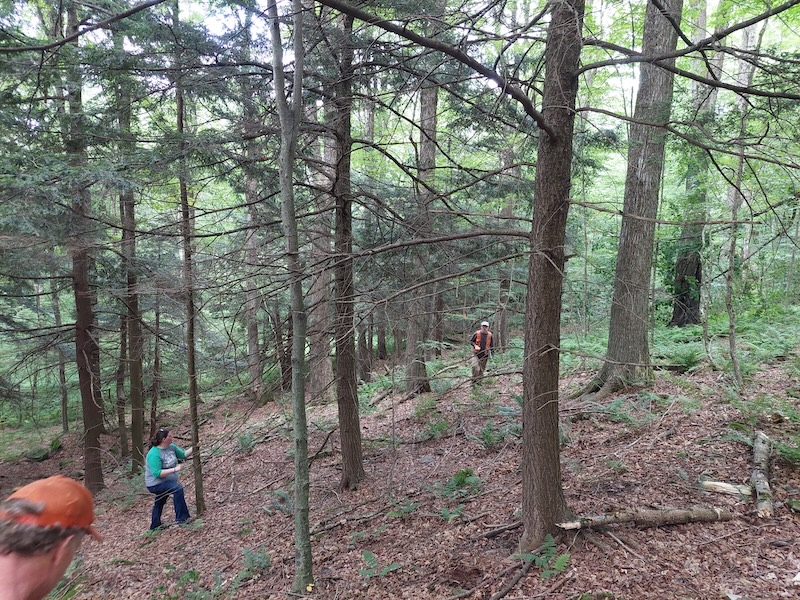
Rod, Corinne, and René mark the upper boundary of the 1.6-acre clearcut. Rod, Corinne, and the hemlocks are IN the clearcut. The big sugar maple to the right is OUT. I have heard that hemlocks are good for making slash walls. This is good news because the clearcut area has a lot of hemlocks in it and slash walls require a lot of material.
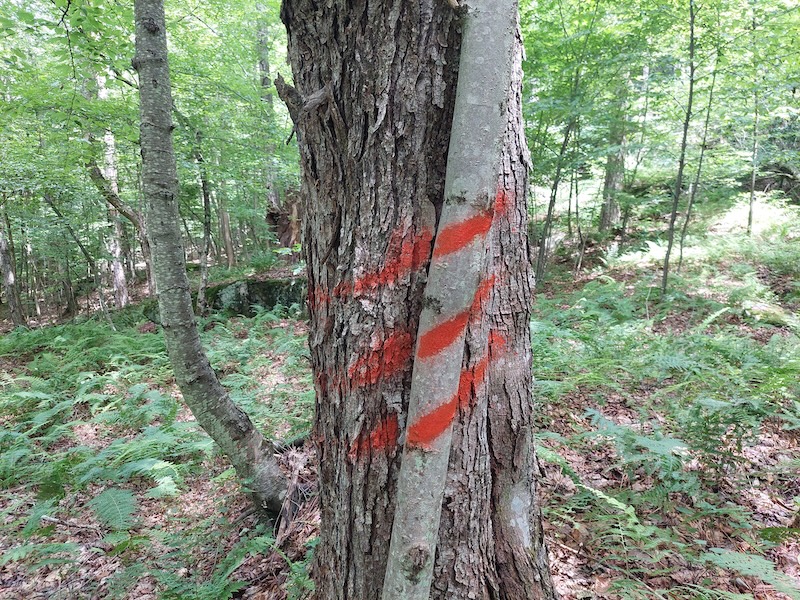
The three stripes signify a corner tree in the rectangular clearcut boundary.
Rod will finish tree marking in the other compartments and advertise this sale to the local forest industry. We should know the winning bidder by the end of Oct. 2025.